Freeman's | Hindman Auction: Western, Wildlife & Sporting Art
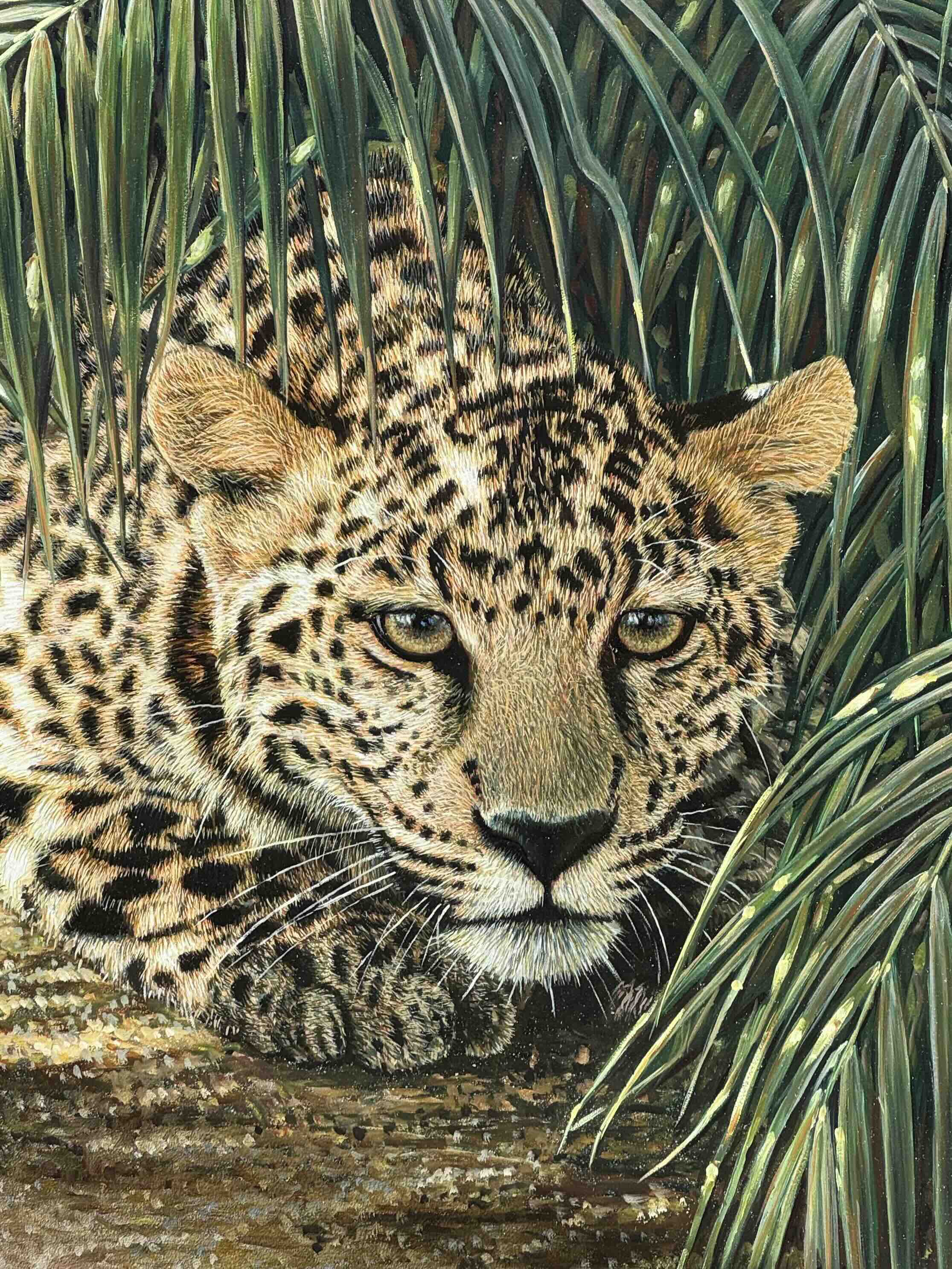
Crouching Leopard
Medium: Oil on Panel
Dimensions: 16 x 19.5", 24 x 27.5" (framed)
Date: 1999
Event: Consigned to Freeman's
The Presence of the Wild: Crouching Leopard (1998)
Crouching Leopard (1999) is a rare and intimate example of Richard Mravik’s early wildlife painting, moving beyond close observation into psychological encounter. Painted with disciplined realism and extraordinary manual precision, the work reflects a pre-digital approach in which time, patience, and direct observation were central to the act of painting.
What distinguishes the image most is its presence. Poised and alert, the leopard meets the viewer with an unwavering gaze, creating a subtle sense of reciprocity. The composition is tightly focused and the surrounding space compressed, intensifying the encounter until the viewer no longer feels outside the scene, but momentarily held within it.
More than two decades later, the painting stands as a testament to the enduring power of hand-executed realism. Its impact comes not only from technical skill, but from the combination of observation, restraint, and human intention that gives the animal its remarkable sense of life.